
Teen Patti vs Rummy: Rules, Hands and Key Differences
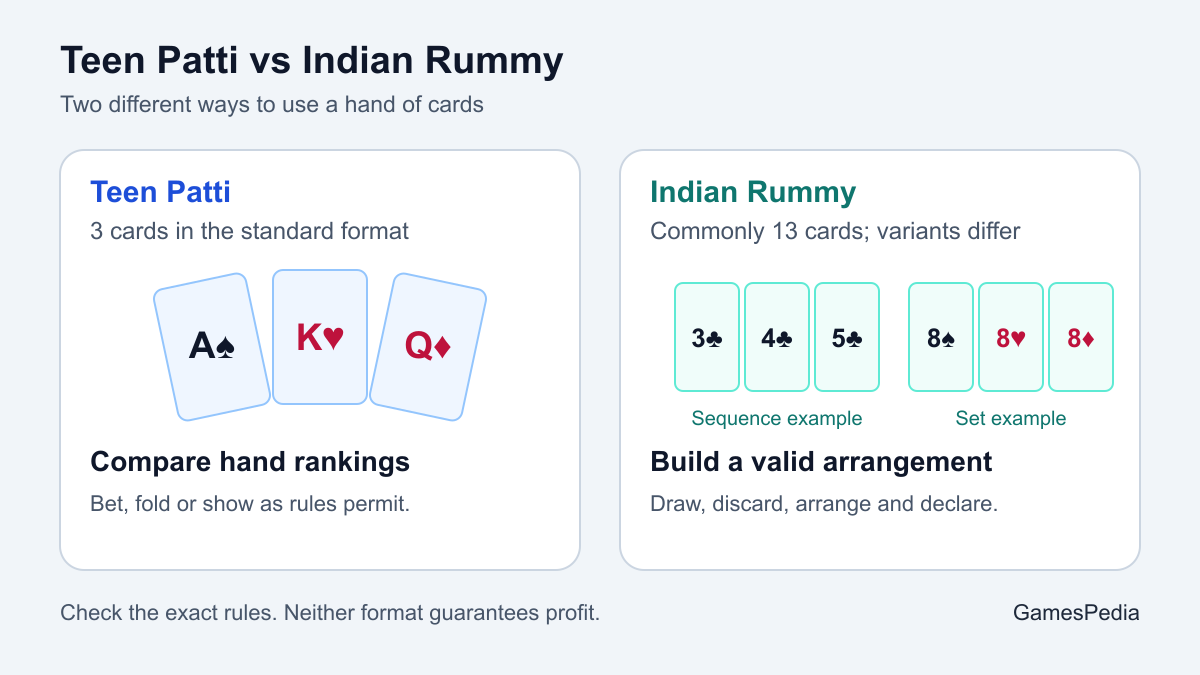
Teen Patti compares three-card hands through betting and, where required, a show. Indian Rummy usually involves drawing and discarding cards to form valid sequences and sets. The central difference is hand comparison versus hand construction. Both involve chance, and neither format guarantees profit.
“Rummy” describes a family of games. The comparison below refers to common Indian Rummy formats; check the exact variant before playing.
How do the rules differ?
Section titled “How do the rules differ?”| Question | Teen Patti | Indian Rummy |
|---|---|---|
| What is the basic objective? | Win the pot under the table’s betting and hand-comparison rules | Complete a valid arrangement and declaration under the variant’s rules |
| What does the hand contain? | Three cards in the standard format | Commonly 13 cards; other Rummy formats differ |
| What does a player do? | Play blind or seen, continue betting, fold, or use a permitted show | Draw, discard, arrange cards, and declare when eligible |
| What is checked? | Relative hand ranking and betting conditions | Sequences, sets, pure-sequence requirements, and scoring |
| Common beginner mistake | Applying another poker game’s rankings or overlooking the current stake | Confusing a set with a sequence or declaring an invalid hand |
| What should be read first? | Hand rankings, blind/seen rules, show conditions | The exact variant’s sequence, joker, declaration, and penalty rules |
These are learning differences, not a legal classification of either game.
Which is easier to learn?
Section titled “Which is easier to learn?”Teen Patti’s three-card comparison can be introduced quickly, but betting and show conditions still need attention. Indian Rummy asks beginners to learn several kinds of combinations and declaration requirements.
Choose the format whose rules you want to study, and practise without money. Ease of understanding does not establish lower financial risk.
Does Rummy involve skill?
Section titled “Does Rummy involve skill?”Remembering cards, managing discards, and arranging combinations can affect decisions in Rummy. Chance still affects the cards available, and format-specific conditions matter. A description of game mechanics should not be treated as a legal conclusion or a promise of earnings.
In Teen Patti, decisions about betting and folding also matter, but they do not reveal opponents’ cards or remove uncertainty.
Can a strategy guarantee a win in either game?
Section titled “Can a strategy guarantee a win in either game?”No. A rules guide can explain a valid action; it cannot guarantee the outcome of a hand or session. Past wins, screenshots, and paid tips do not establish future profit. Adults considering real-money play must check local eligibility and accept the possibility of losing their stake.
What should I read next?
Section titled “What should I read next?”- Teen Patti introduction and how to play.
- Rummy introduction and how to form a valid hand.
- Seven common card-game mistakes.
- Deposit and time limits.
Rules references
Section titled “Rules references”The format descriptions were checked against Pagat’s Teen Patti rules and Indian Rummy rules. These references describe rulesets; the table or app you use may apply variations. See the editorial policy for corrections.