
7 Common Card Game Mistakes and How to Avoid Them
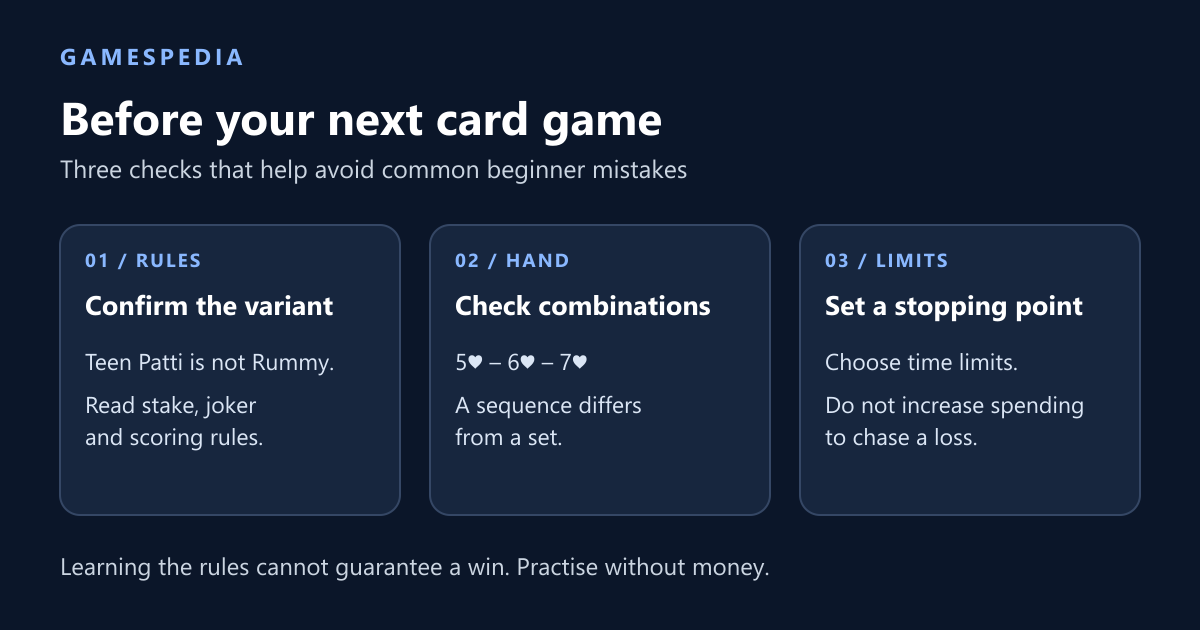
The most common card game mistakes are using the wrong variant’s rules, misreading a hand, overlooking betting conditions, and chasing losses. Before a round, check the rules, practise without money, and decide when to stop. These checks can prevent avoidable errors; they cannot guarantee a win.
This guide covers Teen Patti, Indian Rummy, and Andar Bahar. It is not a poker, blackjack, or solitaire strategy guide. Any real-money format involves loss risk and requires current local-law and age-eligibility checks.
Which mistakes matter in each game?
Section titled “Which mistakes matter in each game?”| Game | Check before playing | A common misunderstanding |
|---|---|---|
| Teen Patti | Hand rankings, blind or seen play, stake limits, and show rules | Assuming poker rankings and betting rules apply unchanged |
| Indian Rummy | The exact variant’s sequence, set, joker, and declaration requirements | Treating every group of three cards as a valid sequence |
| Andar Bahar | The matching-card rule and the table’s payout terms | Treating previous results as a reliable prediction of the next side |
1. Starting without checking the variant
Section titled “1. Starting without checking the variant”A familiar name does not establish the full rules. Agree the number of cards, use of jokers, turn order, scoring, and permitted actions before joining a game. In an app, open the rules rather than relying on an advertisement or a short video.
Start with the card-game overview, then choose the exact game guide.
2. Confusing a sequence with a set in Rummy
Section titled “2. Confusing a sequence with a set in Rummy”A sequence uses consecutive ranks in one suit; a set uses matching ranks in different suits. For example, 5♥–6♥–7♥ is a sequence, while 5♥–5♣–5♦ is a set. They serve different roles in a valid hand.
In common Indian Rummy formats, declaration requirements include sequences and a pure sequence. Joker rules and scoring vary, so check the table’s requirements before declaring. See how to play Rummy and the Indian Rummy rules reference.
3. Importing another game’s hand rankings into Teen Patti
Section titled “3. Importing another game’s hand rankings into Teen Patti”Teen Patti compares three-card hands. Do not assume that a ranking remembered from another poker format applies. Check the order of trail, pure sequence, sequence, colour, pair, and high card, along with the table’s treatment of aces.
The Teen Patti guide introduces the format. Pagat’s Teen Patti rules describe a documented ruleset; a particular table may use a variation.
4. Missing what a bet or declaration commits you to
Section titled “4. Missing what a bet or declaration commits you to”Blind and seen play can change the stake required in Teen Patti. A Rummy declaration may be penalised when the hand is invalid. Before confirming an action, check its cost, whether it can be reversed, and the rule being applied.
Practise the controls without money. Fast tapping is not a substitute for understanding the action.
5. Treating recent results as a prediction
Section titled “5. Treating recent results as a prediction”A run of losses does not establish that a win is due. A screenshot of wins does not demonstrate a reliable system. Avoid paid signals, guaranteed-win groups, and tools claiming to reveal hidden cards or future results.
A better question is whether you understand the current rules and can independently verify a claim.
6. Changing the stopping point after a loss
Section titled “6. Changing the stopping point after a loss”Chasing losses can turn a planned session into additional spending. Set a time limit before starting, keep essential spending out of any gambling budget, and stop when the agreed boundary is reached. Do not raise a limit during a losing session.
Read about deposit and time limits. If stopping is difficult, consider self-exclusion and support instead of another strategy.
7. Choosing an unfamiliar money game before learning the rules
Section titled “7. Choosing an unfamiliar money game before learning the rules”Simple rules do not imply low financial risk. Use a no-money practice format to learn the controls and terminology. Check an operator’s identity, withdrawal conditions, and eligibility before sharing personal information. Choosing not to play remains an option.
Compare Teen Patti and Rummy or read the Andar Bahar introduction before moving between formats.
Can avoiding mistakes guarantee a win?
Section titled “Can avoiding mistakes guarantee a win?”No. Understanding the rules can reduce avoidable errors, but chance, the rules of the format, and other players still affect results. No checklist removes the possibility of losing money.
What should a beginner check first?
Section titled “What should a beginner check first?”Check the game variant, how a valid hand is formed or compared, and what each action costs. If any of those points is unclear, pause and read the rules before joining a round.
Sources and editorial responsibility
Section titled “Sources and editorial responsibility”The rules examples were checked against the two Pagat references linked above. The risk and learning checklist is GamesPedia’s editorial guidance. Read our editorial policy for source and correction standards.